Data & Technology
Thoughtful use of technology lets me leverage my knowledge and experience for more impact. This page highlights some of the ways that I am using APIs, scripts, and AI to monitor government actions, analyze regulatory comments, and make sense of data.
This is a constantly changing environment. I’m happy to talk with you about your ideas, and share what I’ve learned. I might be able to build something for you, or I might give you a few tips that let you do it yourself. For more complicated projects, I can bring in a partner with senior engineering skills.
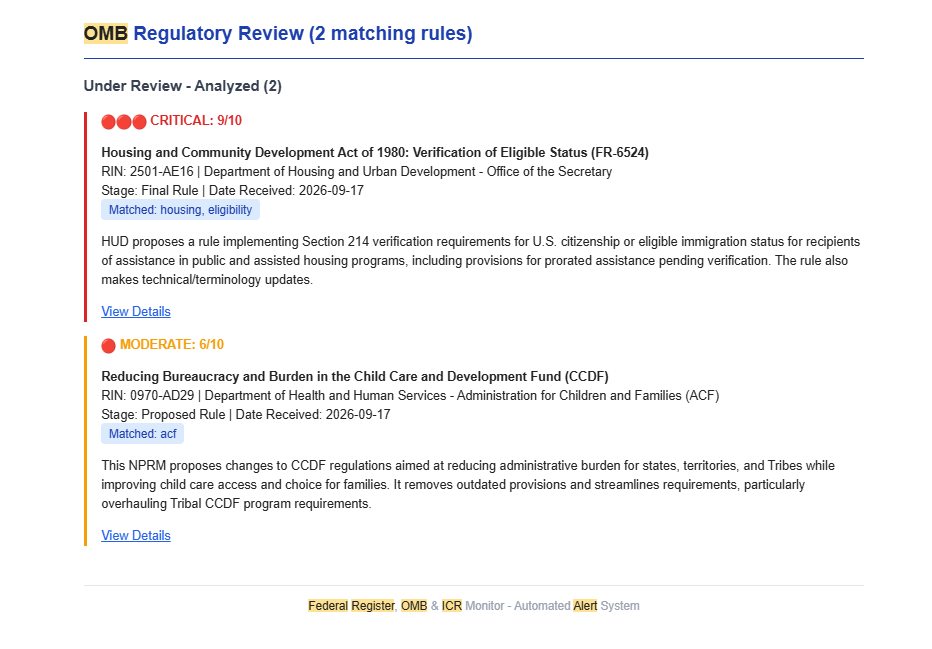
Federal Register, OMB and ICR monitor
To stay on top of planned administrative actions, I was checking multiple government websites daily: the Federal Register, rules under review at OMB under Executive Order 12866, and information collection requests under review. This was tedious and time-consuming, so I built a tool to do it automatically and email me the results each morning. Each item is matched against the programs and populations I care about, scored for how much it matters, and summarized in plain language. I can build a similar monitor for your issues.
Administrative action tracking
For Protecting Immigrant Families, a colleague and I track federal administrative actions affecting immigrant families and benefits. We started tracking in January 2025 with a set of Google Sheets. By early 2026, it was clear that the Google Sheets were no longer up to the job: multiple updates and resources were crammed into a single cell, there was no way to sort by the most recent update, and each entry had to be manually copied from our working draft to the published version, with the links rebuilt.
I redesigned the tracker as a relational database in Airtable — one record per action, with updates and resources as separate linked records that each carry their own draft-to-published status. Records can easily be sorted by agency, type of action, date of last update, litigation status, and more. I also used Claude to develop scripts to migrate the existing data into the database so that it did not need to be reentered.
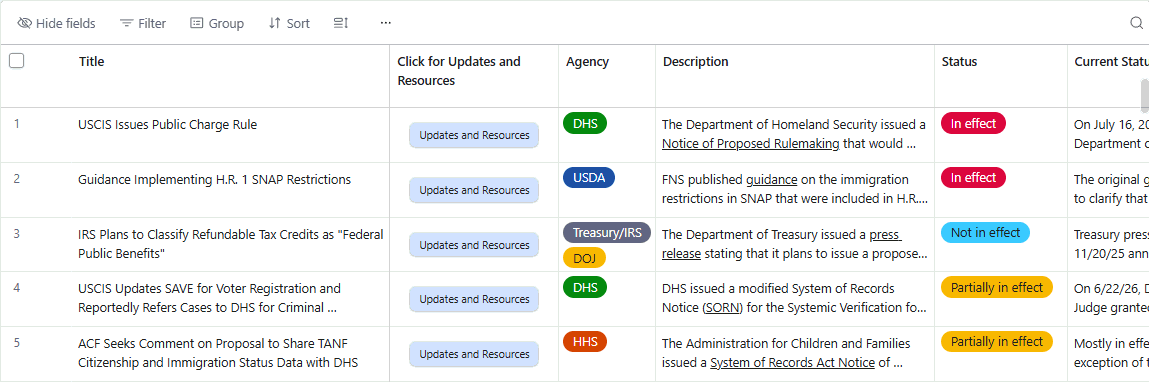
What a single record holds
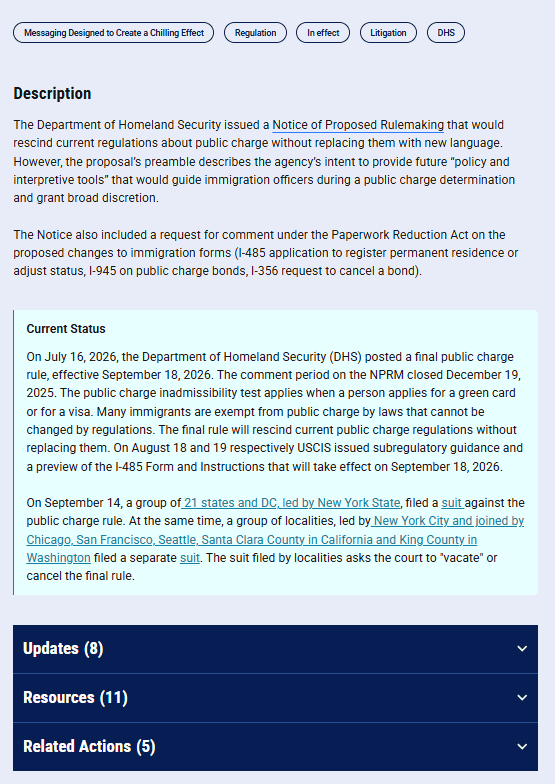
Each action carries its own history as linked records: what the agency did, what has happened since, and where it stands now.
Public comment analysis
Most of the substance of regulatory comments is in attachments, which makes browsing them online painful. I’ve developed a framework to pull comments from regulatory dockets and convert attachments into readable text. This allows me to monitor dockets during the comment period, seeing what comments have been submitted and the arguments they make. After the comment period has closed, I can analyze comments at scale, grouping arguments, finding unlikely champions, and pulling specific citable quotes. The analysis can be customized for the specific purpose, whether litigation or a media strategy.
Data rescue
In working on Thirty Years of Temporary Assistance for Needy Families, I realized that historical data is no longer available on the ACF website. I have compiled historical spending data going back to 1997 and posted it on DataLumos, and am working on adding caseload, work participation rates, and characteristics data as well.
AI policy
AI is a tool, and can be used well or badly. I think it’s important to understand AI’s strengths and weaknesses and how to use it most effectively, not only for my own work, but to be able to provide informed input on agency and nonprofit choices about how and when to use AI. I use AI with caution, testing the assumptions and checking the results along the way, and for the purposes where it allows me and my clients to add the most value. This looks different depending on the type of work:
- Briefs, reports, and other kinds of writing. If I use AI for research or drafting assistance, I read everything closely, generally revise extensively, and take full responsibility for the result, as with anything else I submit to clients or that carries my name.
- Work at a scale no one could read in full, such as converting thousands of public comments into text or compiling decades of historical data. For these, I check the results against known figures when available and spot-check samples. I also tell you what I checked and the limits of that review. I keep the scripts used in the process with the data, so the work can be reproduced and verified.
I never share confidential client materials or private data with AI tools. Of course, I follow clients’ own AI use policies if they are more restrictive.
Working with engineers
I am a policy person, not a software engineer. I work with a senior developer, Tony Lower-Basch, who has spent decades building systems in health, benefits and economic mobility, so a project can grow from something we prototype into something scalable and stable, without handing it to a firm that has to learn the policy from scratch.
If you have a problem that needs both policy judgment and technical skills, get in touch.